Title || Synopsis || Folio 13r || Folio 8r || Folio 9r || Folio 10r || Folio 11r || Folio 12r || Illustrations || Glossary || Sources
Le Livre des tournois — BnF Français 2693
Part IV: Specialized Arms and Armour
Transcription, English translation, and illustrations from René d’Anjou’s medieval tournament treatise.
Synopsis: Explore a transcription and English translation of BnF Français 2693, an illustrated medieval tournament manuscript, with folio images, a glossary, and source notes. A modern translation of the section on Undertaking a Tournament is provided in bold with a transcription of the original French in italics below. Text that was written in red ink is similarly rendered in a red font both in English and French.
UNDER DEVELOPMENT
Folio 13 recto
The text on folio 13 (recto) reads:
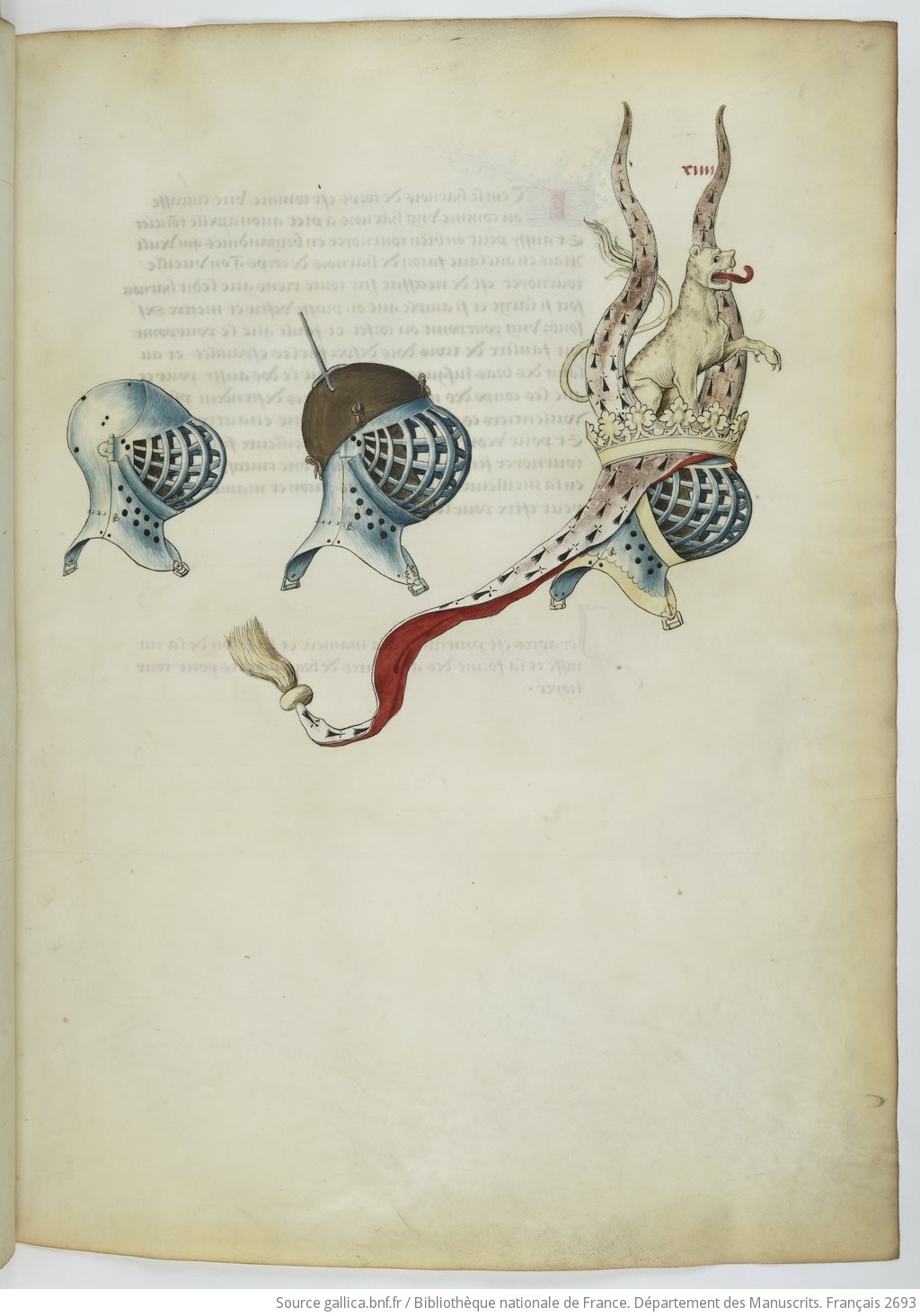
[A]nd to explain it to you more clearly, each piece will be illustrated below, one after another, just as they ought to be..
[N]amely, first of all: The crest must be mounted on a piece of boiled leather (cuir bouilli), which must be well padded with felt to a finger's thickness or more on the inside, and the said piece of leather must cover the entire crown of the helm.And the said piece shall be covered by the lambrequin [mantling] emblazoned with the arms of the one who will wear it.And upon the said mantling, at the very top of the crown, the said crest shall be set, and around it there shall be a torse [twisted wreath] of whatever colors the said tourneyer wishes, about the thickness of an arm, or more or less at his pleasure..
[I]tem: The helm is in the style of a bascinet or a capeline [kettle hat], except that the visor is fashioned differently, just as is painted below. And to make the construction of the crest, the boiled leather (cuir bouilli), and the helm better understood, they will be illustrated below in three views.
[E]t pour mieulx le vous dclairer icy dessoubz sera figure lune piece apres lautre ainsy comme elles douent estre
[C]Est assauoir tout premierement Le timbre doit estre sur vne piece de cuir boully laquelle doit estre bien faultree dun doy despez ou plus par le dedens et doit contenir laditte piece de cuir tout le sommet du heaulme . et sera couuerte laditte piece du lambequin armoye des armes de cellui qui le portera Et sur ledit lambequin au plus hault du sommet sera assiz ledit timbre et autour dicellui aura vng tortis des couleurs que vouldra ledit tournoyeur du gros du bras ou plus ou moins a son plaisir
[I]tem Le heaulme est en facon dun bachinet ou dune capeline . reserue que la visiere est autrement ainsy comme cy dessoubz est paint . Et pour mieulx faire entendre la maniere du timbre du cuir boully et du heaulme . Ilz seront cy dessoubz pourtraiz en trois facons
Folio 7 recto
The text from folio 6 (verso) continues onto folio 7 (recto):
putting it on in the manner of a mantle tied over the right shoulder; and with the good leave of the duke, he shall go unto the Judges-Speakers to know if they will accept the offer to be Judges-Speakers.
And when he comes before them, having letters from both dukes—challenger and defender—with the said piece of cloth over his shoulders as has been said, and above it the parchment attached whereon the said lords shall be painted on horseback, armed and crested as is portrayed hereafter, he shall present them his letters: that is to say, one on behalf of the challenger, and the other on behalf of the defender, which shall be narrative of the things said above, and shall also contain credentials—that is to say, requesting that they be pleased to be Judges-Speakers of the said tournament undertaken by them.
Hereafter is portrayed the manner and way how the King of Arms shows to the four Judges-Speakers the lords challenger and defender, and presents to them the letters of the said lords, having the cloth of gold over his shoulder and the parchment painted with the said two leaders.
la mettant en guise dung manteau noue sur la dextre es- paule / et auec le bon congie du duc sen yra devers les iuges diseurs pour savoir silz wouldront accepter loffre destre iuges diseurs Et quant il sera pardevers ceulx aians lettres des deux ducs appellant et deffendant auecques laditte piece de drap sur les espaules ainsy que dit est et dessus icellui par- chemin atache ou seront paintz lesdiz seigneurs a cheval · armez et timbrez ainsy que cy apres est pourtrait · leur p̅- sentera ses lettres · c'est assavoir vne depar lappellant · et lautre depar le deffendant lesquelles seront narratiues des choses dessusdittes · et aussy contiendront creance C'est assavoir quilz veillent estre iuges diseurs dudit tournoy par eulx empris Puis leur dira les parolles qui cy apres sensuivent
Icy apres est pourtraictie la façon et maniere cõment le roy darmes monstre aux quatre juges diseurs les seigneurs- appellant et deffendant et leur presente les lettres desdiz seigneurs ayant le drap dor sur lespaule et le parchemin paint desdis deux chiefz
Folio 7 verso
Folio 7 (verso) contains a full-page illustration of the King of Arms showing the four Judges and presenting to them the letters of the lords challenger and defender (see first image in Illustrations below).
Folio 8 recto
Folio 8 (recto) is blank as it opposes the previous full-page illustration.
Folio 8 verso
Folio 8 (verso) reads:
[N]oble and redoubted knights, honored and gentle squires: Most high and mighty princes, the Dukes of Brittany and of Bourbon, my most redoubted lords, greet you. And they have charged me to deliver these letters on their behalf, which are in part letters of credence, the contents of which you shall learn after you have read the said letters, and at such hour as shall please you.
[A]fter they have read or had their letters read, and thereupon ask and request to hear the credence, the said King of Arms shall deliver it to them as follows:
[N]oble and redoubted knights, honored and gentle squires: I come before you to advise, request, and notify you, on behalf of the most high and most mighty princes and my most redoubted lords, the Dukes of Brittany and of Bourbon, that—out of the pleasure you desire to do them—you would undertake the charge of ordering and serving as judges and arbiters of a most noble tournament and béhourd [joust] of arms which has recently been proclaimed by them in this realm. These lords, by common consent above all others, have chosen and elected you for this role on account of the great fame of your integrity, renown for wisdom, and praise for virtue, which have long endured in your noble persons. Therefore, do not refuse this request, for much good may ensue from it.
[N]Obles et doubtez cheualiers honnourz et gentilz escuiers · Treshaulx et puissans princes les duz de bretaigne et de bourbon / mes tresredoubtez seigneurs vous saluent · Et me ont chargie de baillier ces lettres de par eulx qui en partie sont de creance / laquelle vo[us] saurez puis apres que aurez leu lesduites lettres et a telle heure quil vous plaira
[A]Pres quilz auront leu ou fait lire leurs lettre et adont quilz demanderont et requerront de oyr la creance ledit roy darmes la leur dira telle que senss[ui]t
[N]Obles et doubtez cheualiers honnourz et gentilz escuiers Je viengs vers vous pour vous aduiser requerir et notiffier / de par treshaulx et trespuissans pri[n]ces et mes tresredoubtez seigneurs les ducz de bretaigne et de bourbon / que sur le plaisir que leur desirez faire vous vueilliez prendre la charge de ordonner et estre Juges diseurs dun tresnoble tournoy et bouhourdeiz darmes qui nouuellement en ce royaume par eulx a este empris Lesquelz seigneurs dun co[m]mun assentement sur tous autres vous ont sur ce choisiz et esleuz pour la grant fame de preudo[m]mie renommee de sens et los de vertue qui de long temps continuent en voz nobles p[er]sonnes Si ne vueilliez de ce estre reffusans Car moult de bien sen pourra ensuir
Folio 9 recto
Folio 9 (recto) reads:
[A]nd first of all, one will thereby be better able to recognize those who are come and descended from ancient nobility, through the bearing of their coats of arms and the displaying of crests.
[S]econdly, those who have offended against honor will be chastised there in such a way that another time they will refrain from doing anything unbecoming to honor.
[T]hirdly, everyone will learn there to strike with the sword, training themselves in the exercise of arms.
[A]nd fourthly, it may perhaps come to pass that some young knight or squire, by acquitting himself well therein, will win favor, grace, or an increase of love from his most noble lady and secret mistress. Therefore, I request of you in court once more, on behalf of my said most redoubted lords—my noble and redoubted knights, honored and gentle squires—that you will deign to be the principal instrument of so many, such great, and such high blessings, in such a manner that through your wisdom, ordering, and guidance the matter may take effect, and in such fashion that renown and fame may spread everywhere for upholding nobility and increasing honor, so that, God willing, every gentleman may henceforth be eager to pursue the exercise of arms more often.
[E]T tout premierement en pourra on mieulx congnoistre lesquelz sont dancienne noblesse venuz et extiruz par le port de leurs armes et leuement de timbres
[S]econdement ceulx qui auront contre honneur failly seront la chastiez tellement que vne autre fois se garderont de faire chose qui soit mal seant a honneur
[T]iercement chacun y aprendra de lespee a frapper en soy habilitant alexercite darmes
[E]T quartement par aduenture pourra il aduenir que tel Jeune cheualier ou escuier par bien y faire y acquerra mercy grace ou augmentation damour de sa tresgente dame et celee maistresse Si vous requiers en cours derchief de par mesdiz tresredoubtez seigneurs mes nobles et doubtez cheualiers honnourez et gentilz escuiers que de tant de telz et si haulz biens vo[us] vueilliez estre principale occasion en telle maniere que par vostre sens ordre et conduicte la chose sorte a effect et par facon que renommee et bruit par tout puisse aller de maintenir noblesse et dacroistre honneur adfin que au plaisir dieu chacun gentil homme doresenauant puisse estre desireux de continuer plus souuent lexercite darmes
Folio 9 verso
Folio 9 (verso) reads:
[T]hen the said Judges-Speakers, if they wish to accept the office, may reply in the form and manner that follows:
"[W]e most humbly thank our most redoubted lords for the honor they do us, for the affection they bear us, and for the trust they place in us. And although there are in this kingdom enough other knights and squires who would know far better than we how to plan and set in order so noble an undertaking as this tournament, nevertheless, in order to obey our most redoubted lords, we offer wholeheartedly to obey and follow them, accepting the office that you have declared before us, to do therein to the best of our loyal abilities all the good that it shall be possible for us to do in this world—employing all our understanding and the labor of our bodies so loyally that if by chance on our part there should be any error (from which may God preserve us), it will be more through simplicity than through malice, submitting ourselves always to the correction, good pleasure, and will of our said most redoubted lords.”
[T]hen the said king of arms must thank the said judge-tellers, and afterward request of them that, as judges, it may please them to appoint for him the day of the said tournament and the place as well, so that he may have it proclaimed as is fitting. And all the judge-tellers must go together into council to decide upon the day and the place, so that […]
_[L]**ors lesdiz Iuges diseurs silz veullent accepter loffice pourront respondre en la forme et maniere qui sensuit ·_
[N]ous remercions treshumblement noz tresredoubtez seigneurs de lonneur quilz nous font de lamour quilz nous portent et de la fiance quilz ont en nous Et combien quil y ait en ce royaulme assez dautres cheualiers et escuiers qui de trop mieulx que nous sauroient deuiser et mettre en ordre vng sy noble fait comme est cellui du tournoy Neantmoins pour obeir a noss tresredoubtez seigneurs nous offrons de bon cuer a les obeir et suir En acceptant la charge que cy deuant nous auez declairee pour y faire a noz loyaulx pouoirs tout le bien que possible nous sera dy faire en ce monde En employant tout nostre entendement et la paine de noz corps sy loyaument que se par cas dauenture de nostre coste y auoit erreur dont dieu nous gard Ce sera plus par simplesse que par vice nous soubz mettant tousiours a la correction bon plaisir et wulente de nosdiz tresredoubtez seigneurs
[L]ors ledit roy darmes doit remercier lesdiz Iuges diseurs Et en apres leur requerir que comme Iuges il leur plaise lui ordonner le iour dudit tournoy et le lieu aussy adfin quil le
Folio 10 recto
The text from folio 9 (verso) continues onto folio 10 (recto):
the said King of Arms shall go [and] begin to proclaim the said tournament in the places where it is fitting—namely, first at the court of the challenger lord, secondly at the court of the defender lord, and thirdly at the court of the king and elsewhere where it shall be decided by the said Judges-Speakers. And if the said King of Arms could not or did not wish to go in person to the court of the other lords to proclaim the said tournament, he may send a pursuivant to each court to do so; but to the court of the said two lords who are heads of the tournament, and also of the king, the said King of Arms must go in person.
[T]hus hereafter follows the form and manner in which the said tournament must be proclaimed. And first of all, the said King of Arms must be accompanied by three or four heralds and pursuivants when he proclaims the said festival of the tournament in the form and manner that is illustrated hereafter.
Ledit roy darmes aille commencera crier ledit tournoy es lieux ou il appartient Cestassauoir premierement a la court du seigneur appellant Secondement ala court du seigneur deffendant Et tiercement ala court du roy et ailleurs ou il sera aduise par lesdiz Iuges diseurs Et se ledit roy darmes ne pouoit ou vouloit aler en personne ala court des autres seigneurs pour crier ledit tournoy Il pourra enuoyer a chascune court vng poursuiuant pour le faire Mais a la court desdiz deux seigneurs chiefz du tournoy · et aussi du roy fault que ledit roy darmes aille personnellement
[A]Insi cy apres sensuit la forme et maniere comment on doit crier ledit tournoy Et tout premierement ledit roy darmes doit estre acompaigne de trois ou quatre heraulx et poursuiuans quant il criera laditte feste du tournoy en la forme et maniere que cy apres est historie
Folio 10 verso
Folio 9 (verso) gives a description of the illustration that follows on the next page:
Hereafter is portrayed the fashion and manner in which the King of Arms—having the cloth of gold upon his shoulder, and the two heads painted upon the parchment, and in the four corners the four escutcheons of the said Judges painted—proclaims the tournament; and how the pursuivants distribute the escutcheons of the Judges' arms to all those who wish to take them.
Icy apres est pourtrautie la facon et maniere comment le roy darmes ayant le drap dor sur lespaule et les deux chiefz pains sur le parchemin et aux quatre coings les quatre escussons desdiz Juges pains Et crie le tournoy Et comment les poursuiuans baillent les escussons des armes des Juges a tous ceulx qui en veullent prendre._
Folio 11 recto
Folio 11 (recto) contains a full-page illustration of how the pursuivants give a little shield with the arms of the judges to all who wish to take part (see second image in Illustrations below).
Folio 11 verso
Folio 11 (verso) reads:
[B]e it known that as soon as the Judges-Speakers have accepted their office, the King of Arms shall have the four shields of the said Judges-Speakers hung at the four corners of the said parchment—namely, those of the two knights at the top, and those of the two squires at the bottom.
[A]nd first, one of the pursuivants of the King of Arms’s company who has the loudest voice must cry out in three loud breaths or three long pauses:
Now hear ye, now hear ye, now hear ye!
[B]e it known to all princes, lords, barons, knights, and squires of the March of Île-de-France, of the March of Champagne, of the March of Flanders, and of the March of Ponthieu, chief of the Poyers, of the March of Vermandois and Artois, of the March of Normandy, of the March of Aquitaine and Anjou, of the March of Brittany and Berry, and also of Corbie, and to all others of whatever marches there may be of this kingdom and of all other Christian kingdoms—provided they are not banished from or enemies of the king our lord, to whom may God grant a good life—that on such-and-such a day of such-and-such a month in […]
[E]st assauoir que Incontinent que les Iuges diseurs ont accepte la charge que le roy darmes fera prendre les quatre escus diceulx Iuges diseurs aux quatre corniers dudit parchemin Cest assauoir ceulx des deux cheualiers en hault · et ceulx des deux escuiers en bas
[E]t premierement lun des poursuiuans de la compaignie du roy darmes qui plus haulte Voix aura doit crier par trois haultes allenees ou trois grandes reposees
Or ouez · or ouez · or ouez
[O]n fait assauoir a tous princes seigneurs barons cheualiers et escuiers de la marche de lisle de france · de la marche de champaigne · de la marche de flandres · et de la marche de ponthieu chief des poyers · de la marche de vermendois et dartois · de la marche de Normandie de la marche dacquitaine et danIou · de la marche de bretaigne et de berry et aussy de corbye et a tous autres de quelconques marches qui soient de ce royaulme et de tous autres royaulmes crestiens silz ne sont bannis ou ennemis du roy nostre sire a qui dieu doint bonne vie · que tel Iour de tel mois en
Folio 12 recto
The text from folio 11 (verso) continues onto folio 12 (recto):
in such-and-such a place of such-and-such a locality, there shall be a great designated passage of arms and most noble tournament, fought with regulation maces and blunted swords, in armor properly made for this purpose, with helm-crests, coats of arms, and horse trappings emblazoned with the arms of the noble tourneyers, just as from all antiquity is customary.
[O]f which tournament the heads are the most high and most mighty princes and my most redoubted lords, the Duke of Brittany as appellant, and the Duke of Bourbon as defendant.
[A]And therefore, it is once again made known to all princes, lords, barons, knights, and squires of the aforementioned marches and others of whatever nations they may be—provided they are not banished from or enemies of the king, our said lord—who shall have the will and desire to tourney in order to win honor, that they wear the small escutcheons which I shall distribute right now so that it may be known that they are among the tourneyers. And therefore, let whoever wishes to have some ask for them; which escutcheons are quartered with the arms of the said four knights and squires, Judges-Speakers of the said tournament.
tel lieu de telle place sera vng grant desinne pardon darmes et tresnoble tournoy frappe de masses de mesure et espees rabatues en harnois propres pour ce faux en timbres cottes darmes et housseurs de cheuaulx armoyees des armes des nobles tournoyeurs ainsy que de toute anciennete est de coustume
[D]vquel tournoy sont chiefz treshaulx et trespuissans princes et mes tresredoubtez seigneurs le duc de bretaigne pour appellant · Et le duc de bourbon pour deffendant ·
[E]t pour ce fait on de rechief assauoir a tous princes seigneurs barons cheualiers et escuiers des marches dessusdittes et autres de quelzconques nacions quilz soient non banniz ou ennemiz du roy nostredit seigneur qui auront vouloir et desir de tournoyer pour acquerir honneur quilz portent des petis escussons que cypresentement donneray adfin que on congnoisse quilz sont des tournoyeurs · Et pour ce en demande qui en vouldra auoir Lesquelz escussons sont esquartelez des armes desdis quatre cheualiers et escuiers Iuges diseurs dudit tournoy
Folio 12 verso
Folio 12 (verso) concludes the announcements and introduces the section on tournament arms, armour, and accoutrements:
[A]nd at the said tournament there shall be noble and rich prizes given by the ladies and maidens.
[F]urthermore, I announce to all of you princes, lords, barons, knights, and squires who intend to tourney that you are required to present yourselves at your lodgings on the fourth day before the day of the said tournament in order to display your coats of arms from the windows (faire fenestres de blasons), on pain of not being admitted to the said tournament. And this I make known to you on behalf of my lords the judge-tellers, and pardon me if you please.
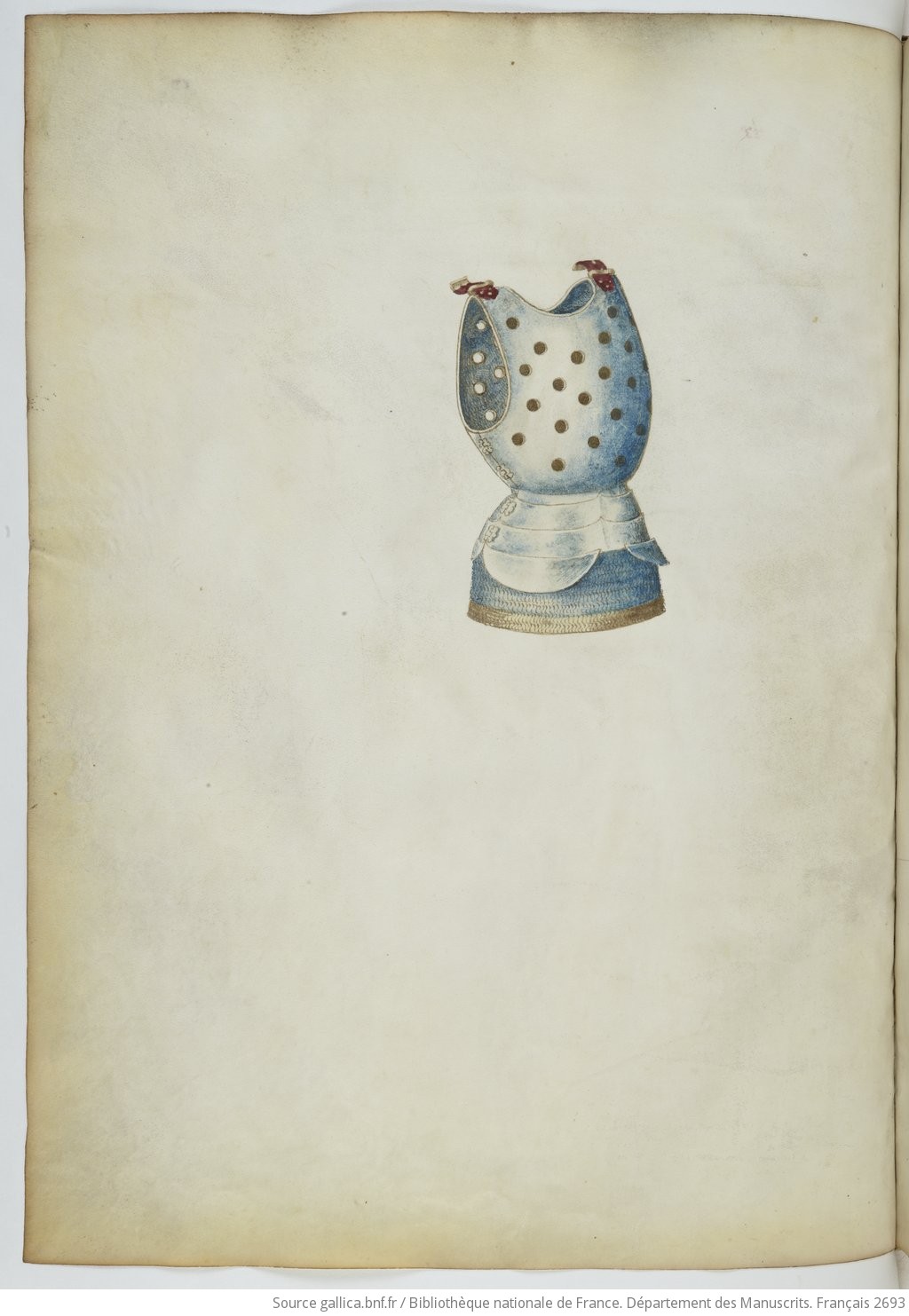
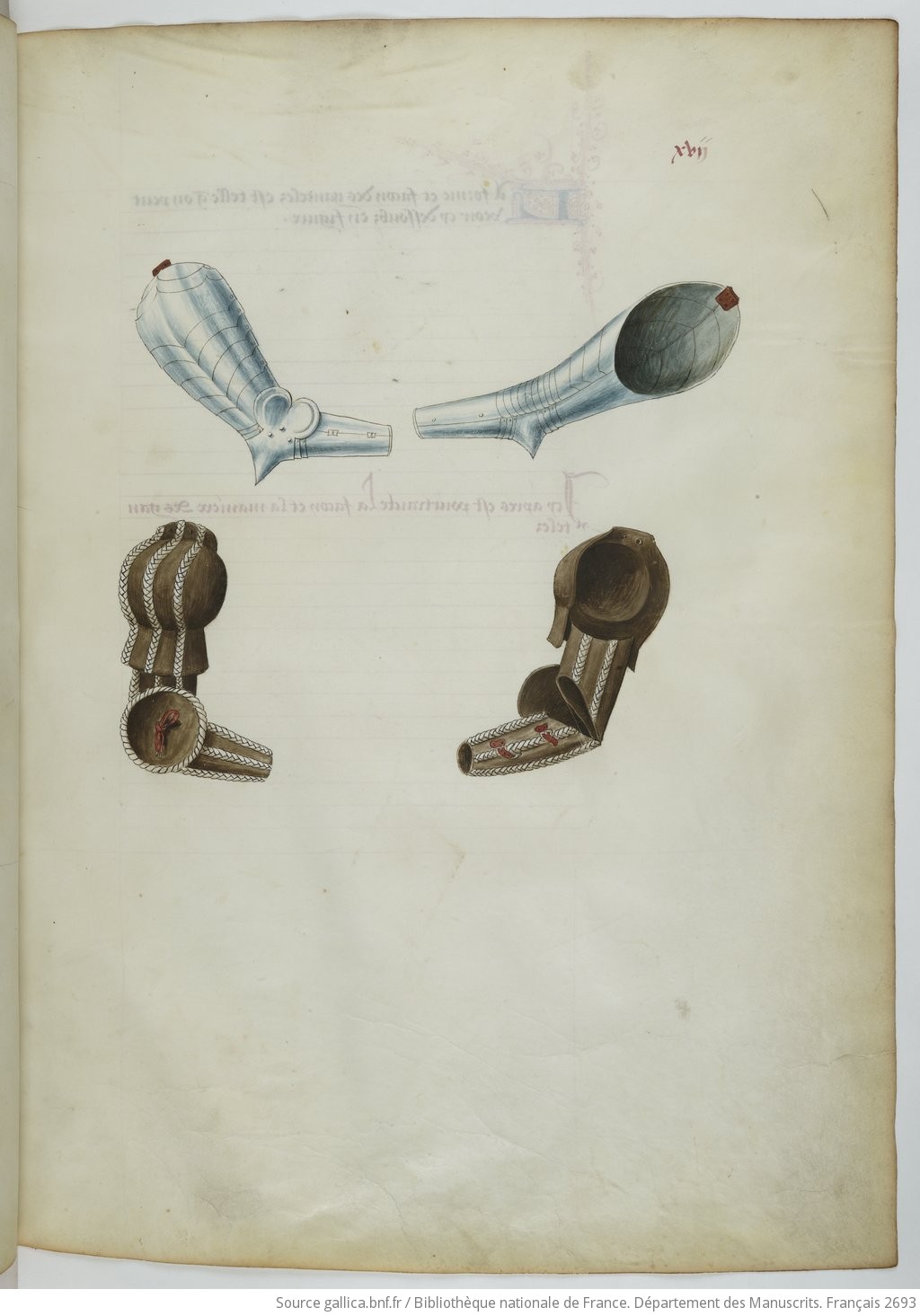
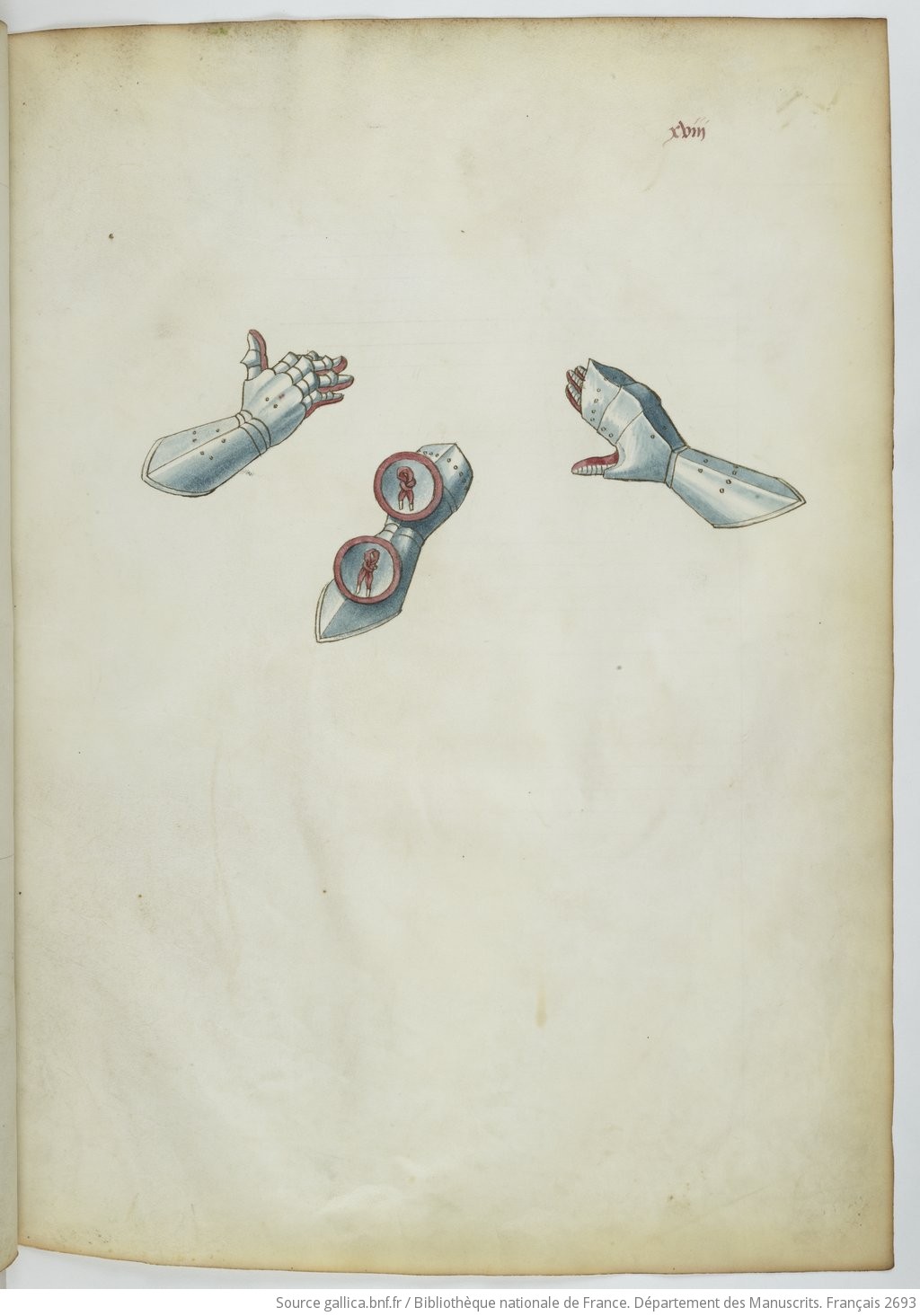
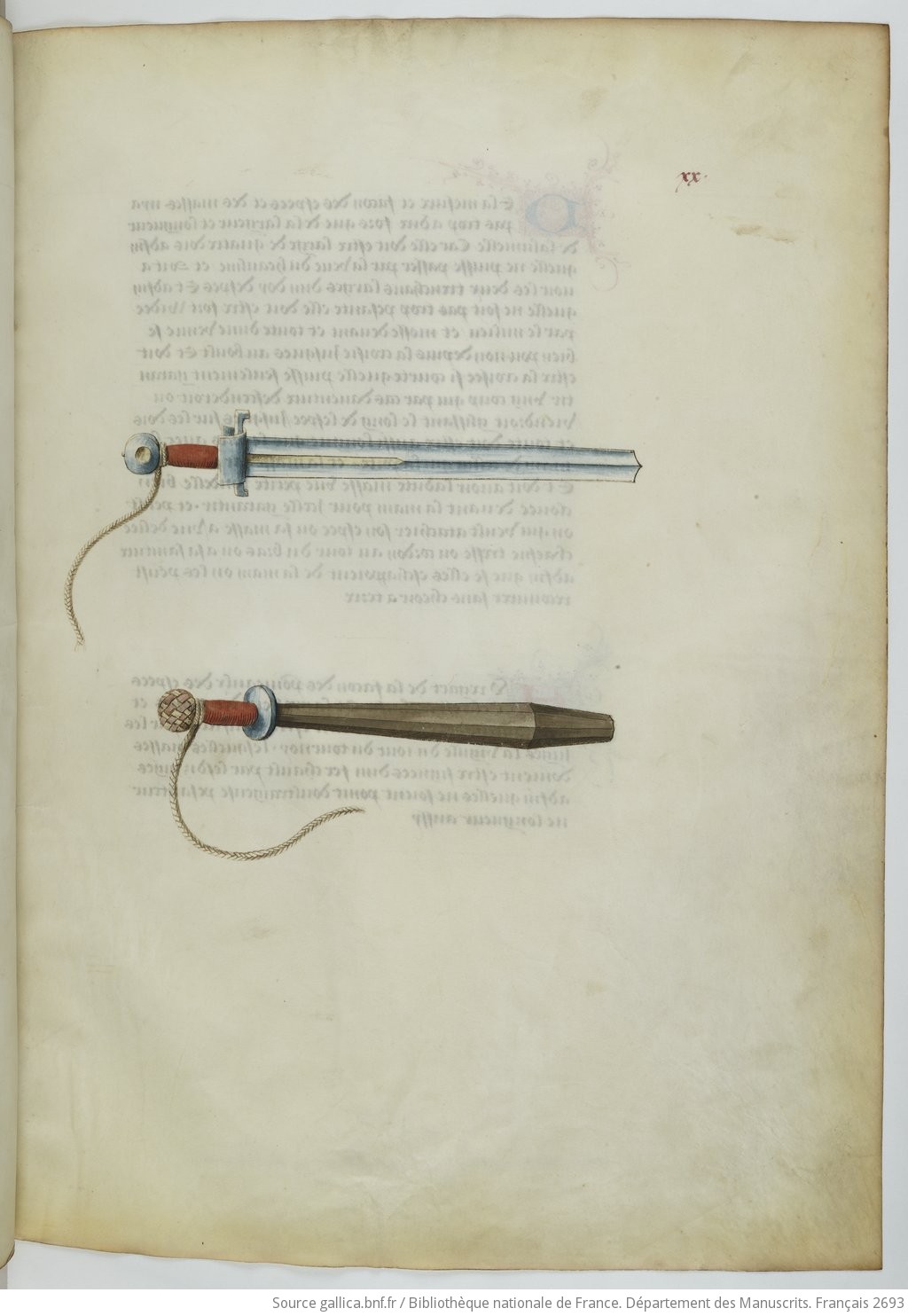
Hereafter follows the fashion and manner in which must be made the armor for the head, body, and arms; helm-crests and lambrequins—which in Flanders, Brabant, and those high countries where tournaments are commonly practiced are called hacheures or hachemens—coats of arms, saddles, padded horse-trappings, and horse caparisons, maces, and swords for tourneying.
[E]t audit tournoy y aura de nobles et riches pris par les dames et damoiselles donnez
[O]vltre plus ie anonce a entre vous tous princes seigneurs barons cheualiers et escuiers qui auez intencion de tournoyer que vous estes tenuz vous rendre es herberges les quatriesme iour deuant le iour dudit tournoy pour faire de voz blasons fenestres sur paine de non estre receuz audit tournoy Et cecy vous fay ie assauoir de par messeigneurs les Iuges diseurs et me pardonnez sil vous plaist
Icy apres sensuit la facon et maniere dont doiuent estre les harnois de teste de corps et de bras timbres et lambequins que on appelle en flandres et en brabant et en ces haulx pays ou les tournoys sevsent communement hacheures ou hachemens cottes darmes selles hours et housseures de cheuaulx masses et espees pour tournoyer
Illustrations
Previous Section: Undertaking a Tournament
Next Section: Specialized Arms and Armour - Still Under Development
GLOSSARY OF TERMS
Banneret - a knight banneret led troops under his own square-shaped banner as opposed to a tapering standard or pennon flown by lower-ranking knights. Under English custom the rank of knight banneret could only be conferred by the sovereign on the field of battle
Bascinet - fully enclosed helmet attached to the breastplate and backplate, making it difficult to remove; helmets for a duel often had a locking visor, although most war visors did not lock in place.
Cuisses - armour for protecting the upper legs consisting of articulated and hinged plates enclosing the thigh, side, and back of the legs from groin to knees.
Defendant - the party or representative defending against the charge or suit; in tournaments, the side being challenged.
Fustian - a thick, coarse cloth made of wool and linen similar to modern corduroy.
Greaves - armour for the lower legs; a pair of hinged plates enclosing the legs from the knee to the ankles.
Gussets - sections of maille to cover small openings such as the elbow.
Judges-Speakers - imperfect translation of the French Juges diseurs referring to a type of judges who would make announcements.
King of Arms - expert in heraldry and noble lineages.
Lists - wooden fence-like barriers that surround a tournament field, whether for mounted or dismounted combat.
Rerebrace - armour protecting the upper arm between the armpit and elbow, formed from a single C-shaped plate or a pair of hinged plates.
Sabatons - armour for the feet made of overlapping lames of steel.
Sabatons - armour for the feet made of overlapping lames of steel.
Torse - a wreath-like crown normally made of two fabrics twisted together and worn atop the helmet.
Voiders - sections of maille to cover the gaps in the armour such as the armpit, inner elbows, and backs of legs and/or knees.
Sources:
Source: Bibliothèque nationale de France. Département des Manuscrits. Français 2693Author: René I (duc d'Anjou ; 1409-1480). Auteur du texte. René I d’Anjou, Traité de la forme et devis comme on peut faire les tournois. 1401-1500
Translation and transcription by Gemini 3.6, November 2026.