Title || Synopsis || Folio 23r || Folio 24r || Folio 25r || Folio 26r || Folio 27r || Illustrations || Glossary || Sources
Le Livre des tournois — BnF Français 2693
Part V: Barding for the Horse
Transcription, English translation, and illustrations from René d’Anjou’s medieval tournament treatise.
Synopsis: Explore a transcription and English translation of BnF Français 2693, an illustrated medieval tournament manuscript, with folio images, a glossary, and source notes. A modern translation of the section on Armour for the Horse is provided in bold with a transcription of the original French in italics below. Text that was written in red ink is similarly rendered in a red font both in English and French.
Folio 22 recto
The text on folio 22 (recto) continues from folio 21 (verso) in Specialized Arms and Armour which ended with: "And with regard to their saddles [...]"
...they are of the height that used to be worn at the joust in France in former times, and their peytrals and shaffron [chaufrain] are of leather as well. And a few of them have been seen in this equipment who, when they were on horseback, could neither help themselves nor turn their horses, so bulky were they. And to return to the true and more refined fashion, the manner of arming men as touched upon above is far finer and safer. And war saddles are also good for tourneying when they are very tightly closed at the back and should not be too high in the front saddlebow
[A]nd with regard to their maces, swords, and leg harnesses, they are similar to those described earlier.
[F]urthermore, a kind of padded hourt is very necessary there, which is attached in front to the saddlebow, both high and low in several places, as well and as securely as possible. And it extends down along the front bars [aulves] of the saddle while embracing the horse's chest; this hourt is good for protecting the horse or destrier from injuring its shoulder against the impact when colliding in a charge, and it also preserves the tourneyer's leg from all wrenches
elles sont de la haulteur dont on les souloit porter ala Jouste en france anciennement et les pysieres et le chaufrain de cuir aussy Et moins deulx a len veu en cest habillement lesquelz quant ilz estoient a cheual ne se pouoient aidier ne tourner leurs cheuaulx tellement estoient grous Et pour reuenir ala vraye et plus gente facon la maniere darmer les personnes ainsy comme dessus est touchie est dassez plus belle et plus seure Et les selles de guerre aussy sont bonnes pour tournoyer quant elles sont bien fort closes derriere et ne veullent pas estre trop haultes darchon deuant
[E]T au regard de leurs masses espees et harnois de Jambes elles sont semblables de celles dont deuant est deuise
[O]Vltre plus y est tresnecessaire vne facon de hourt que on atache deuant a larchon de la selle tant hault que bas en plusieurs lieux le mieulx que on peult et le plus seurement Et descend le long des aulues de la selle deuant en embrassant la poitrine du cheual lequel hourt est bon pour garantir le cheual ou destrier despauler contre le hurt quant on vient de choc et preserue aussy la Jambe du tournoyeur de toutes estorses
Folio 22 verso
Folio 22 (verso) reads:
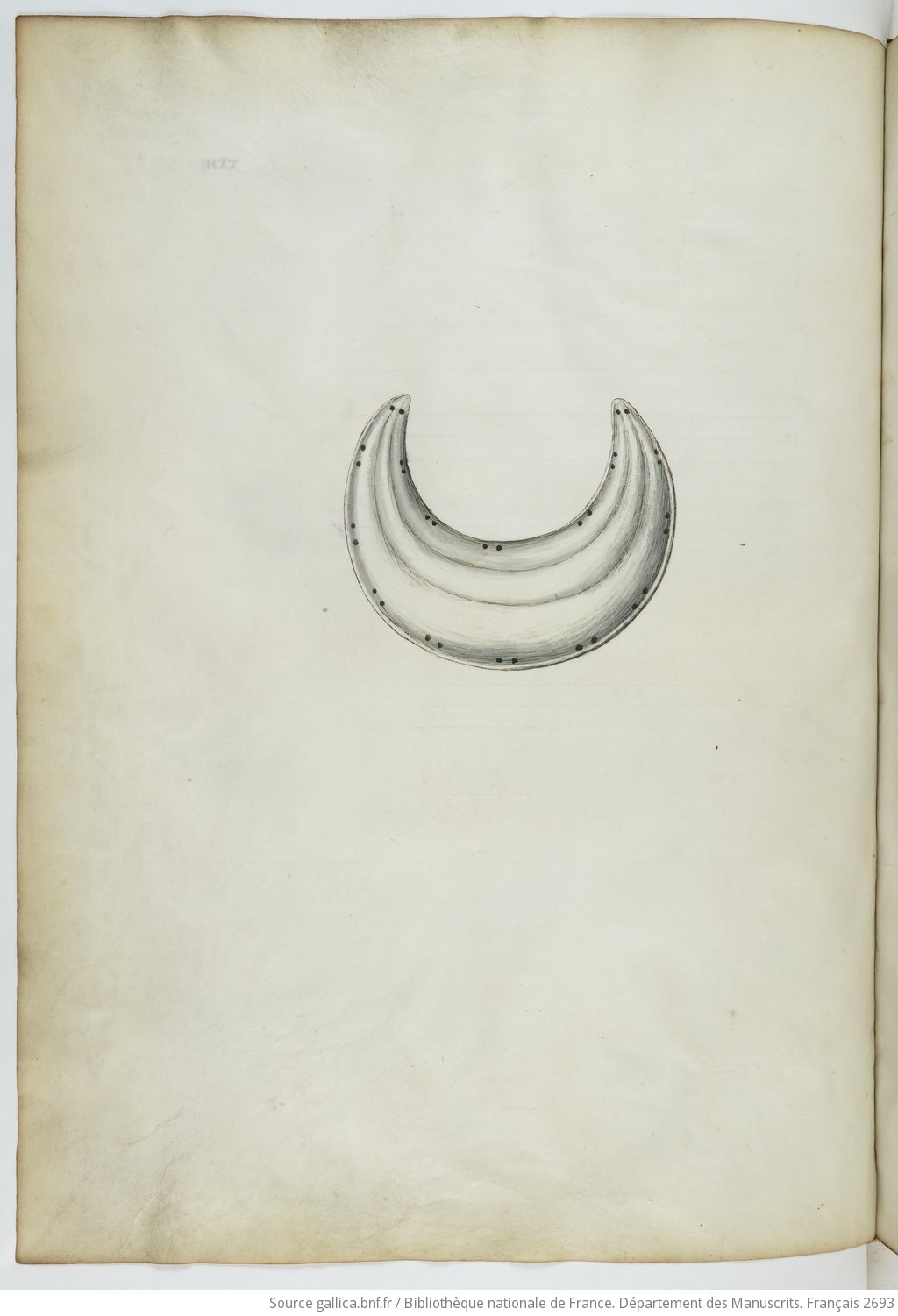
[T]his hourt is made of long straw between layers of linen heavily quilted with whipcord, and inside the said hourt there is a sack filled with straw and shaped like a crescent, attached to the said hourt, which rests upon the horse's chest and holds up the said hourt so that it does not strike against the horse's legs. And in addition to the said quilting, there are, if one wishes, rods sewn inside that keep it stiff without buckling. And the design of the said hourt is depicted below, both inside and outside, so that one may see both; and how the said sack is placed inside the said hourt, the design of which sack is as follows:
Hereafter is depicted the design and manner of the sack to be placed inside the hourt.
[C]E hourt est fait de paille longue entre toilles fort pourpointees de cordes de fouet / et dedens ledit hort ya vng sac plain de paille et facon dun croissant atachie audit hourt qui repose sur la poitrine du cheual et relieue ledit hourt adfin quil ne hurte contre les Jambes du cheual Et en oultre ledit pourpointement ya qui veult bastons cousuz dedens qui le tiennent roide sans gauchir Et est la facon dudit hourt cy dessoubz pourtraitte tant alenuers comme alendroit adfin que on voye lune et lautre · / et comme on met ledit sac dedens ledit hourt la facon duquel sac est ainsy
Jcy apres est pourtraitte la facon et la maniere du sac pour mettre dedens le hourt
Folio 23 recto
Folio 23 (recto) is blank as it opposes the subsequent full-page illustration.
Folio 23 verso
Folio 23 (verso) contains a full-page illustration of the design and manner of the sack to be placed inside the hourt (see first image in Illustrations below).
Folio 24 recto
Folio 24 (recto) reads:
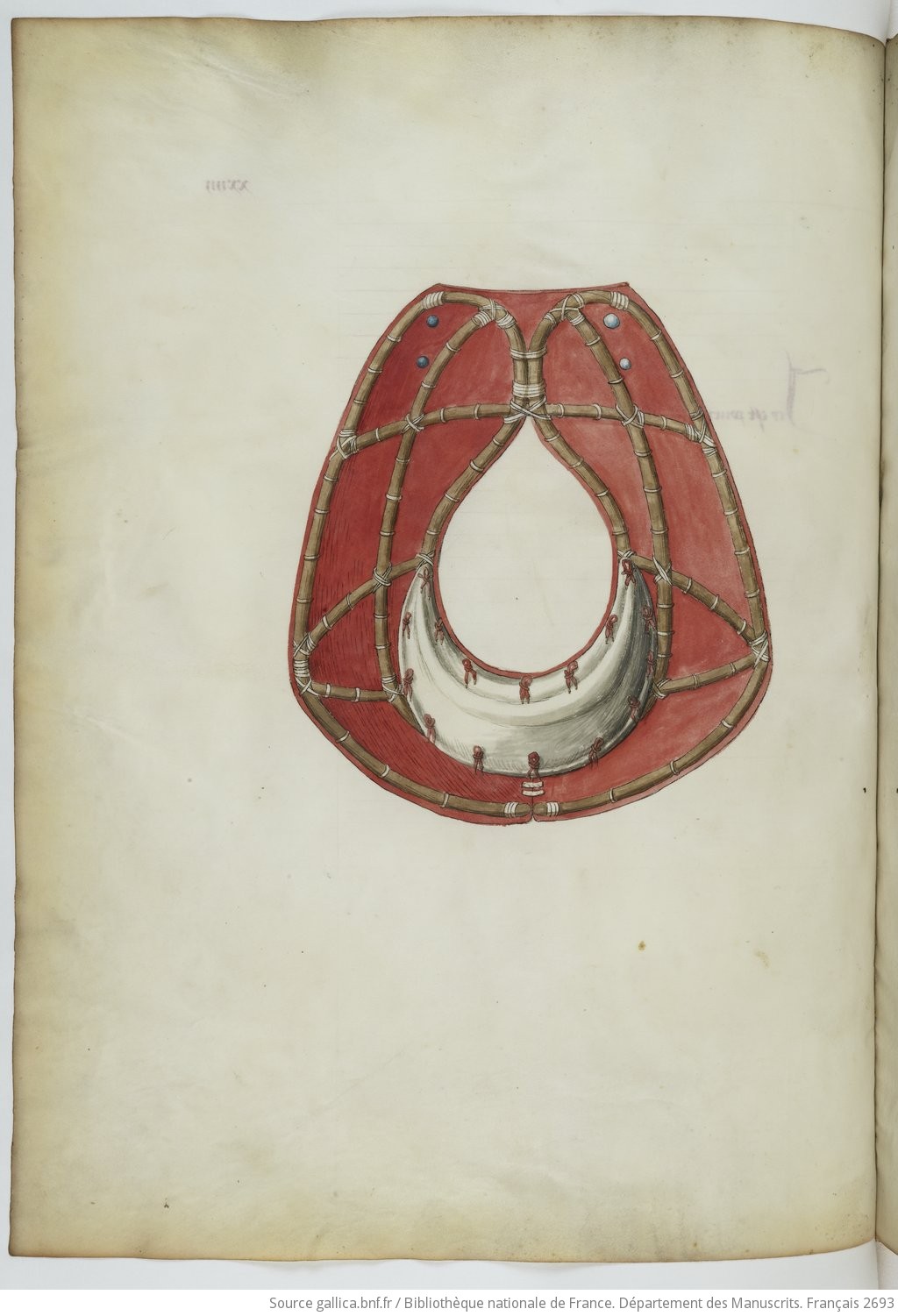
Here is depicted the illustration of the hourt from the back (inside).
Jcy est pourtraitte listoire du hourt a lenuers_
Folio 24 verso
Folio 24 (verso) contains a full-page illustration of the hourt from the inside (see second image in Illustrations below).
Folio 25 recto
Folio 25 (recto) reads:
[T]he hourt from the back (inside) is just as it was similarly depicted earlier.
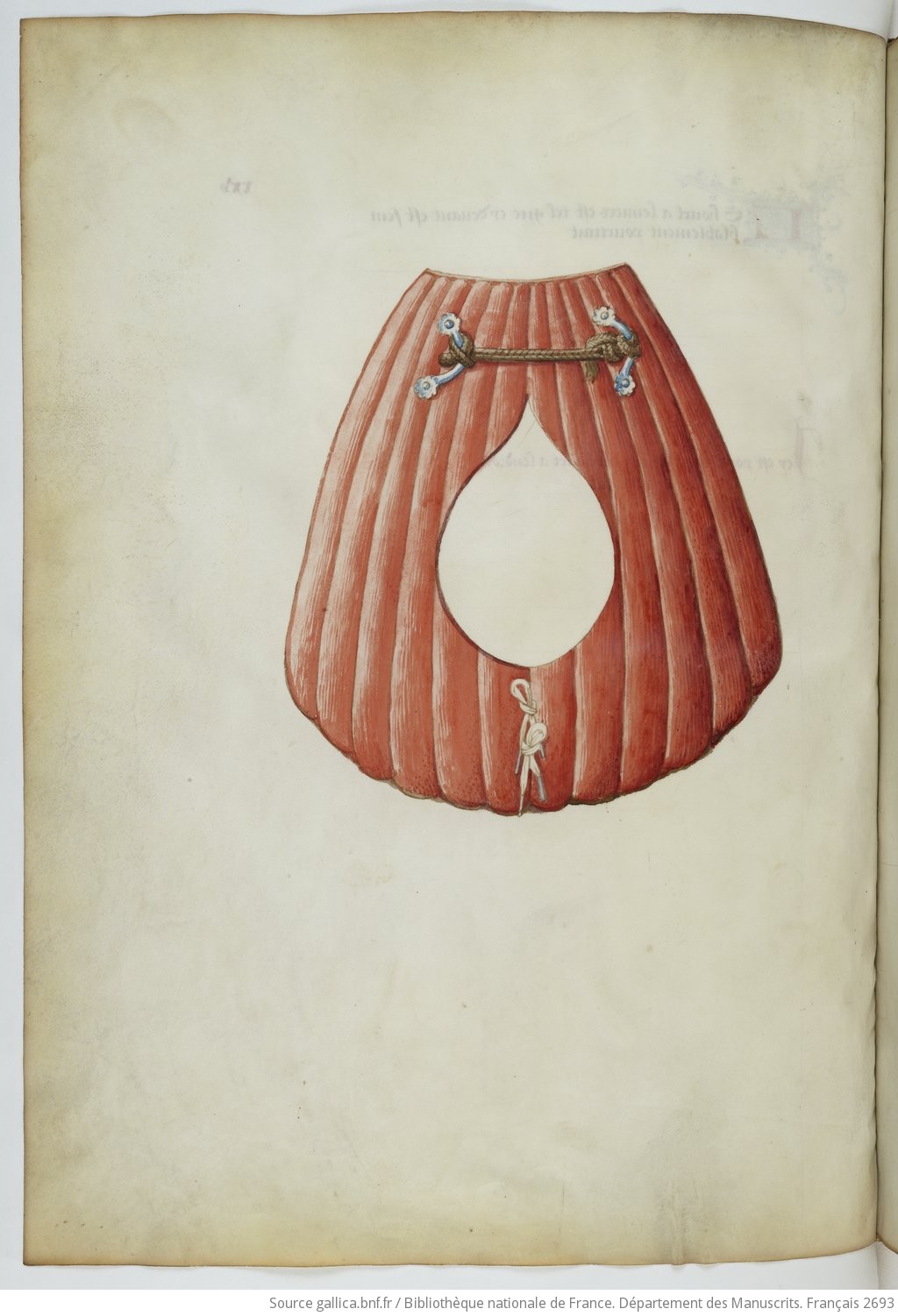
Here is depicted the illustration of the hourt from the front (outside).
[L]E hourt a lenuers est tel que cy deuant est semblablement pourtrait
Jcy est pourtraitte listoire du hourt a lendroit
Folio 25 verso
Folio 25 (verso) contains a full-page illustration of the illustration of the hourt from the front (outside) (see third image in Illustrations below).
Folio 26 recto
Folio 26 (recto) reads:
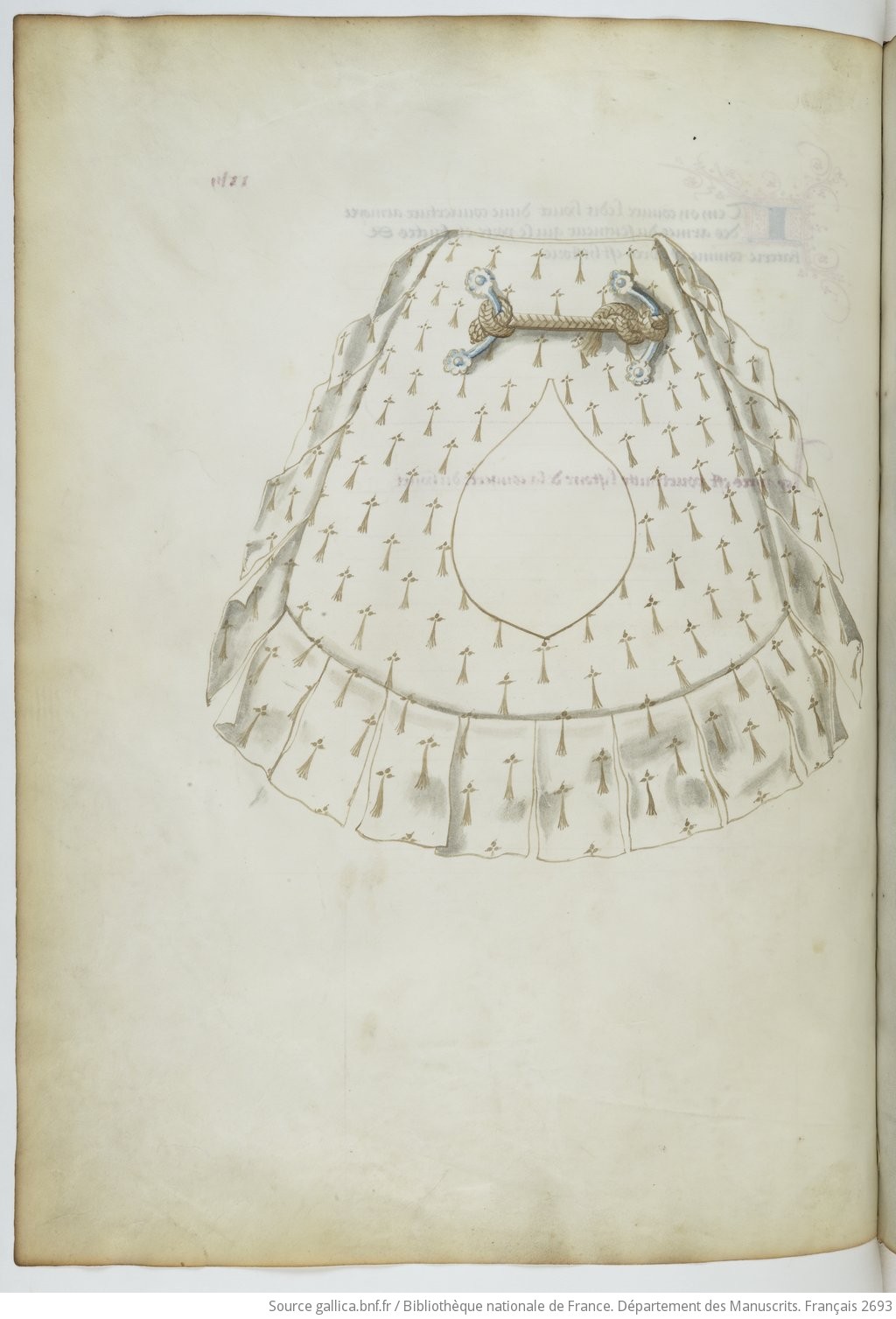
[I]tem, the said hourt is covered with a covering emblazoned with the arms of the lord who bears it and made of beaten metalwork [baterie], as is illustrated hereafter.
Hereafter is depicted the illustration of the covering of the hourt.
[I]Tem on couure ledit hourt dune couuerture armoyee des armes du seigneur qui le porte et faictes de baterie comme cy apres est historie
Jcy apres est pourtraitte listoire de la couuerte du hourt_
Folio 26 verso
Folio 26 (verso) contains a full-page illustration of the illustration of the covering of the hourt (see fourth image in Illustrations below).
Folio 27 recto
Folio 27 (recto) reads:
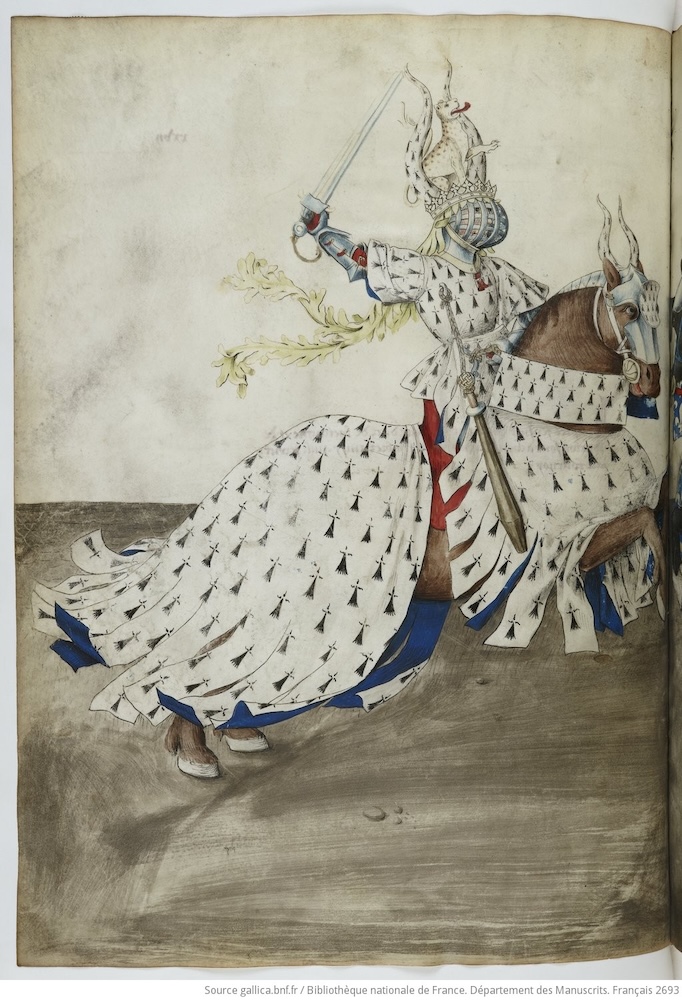
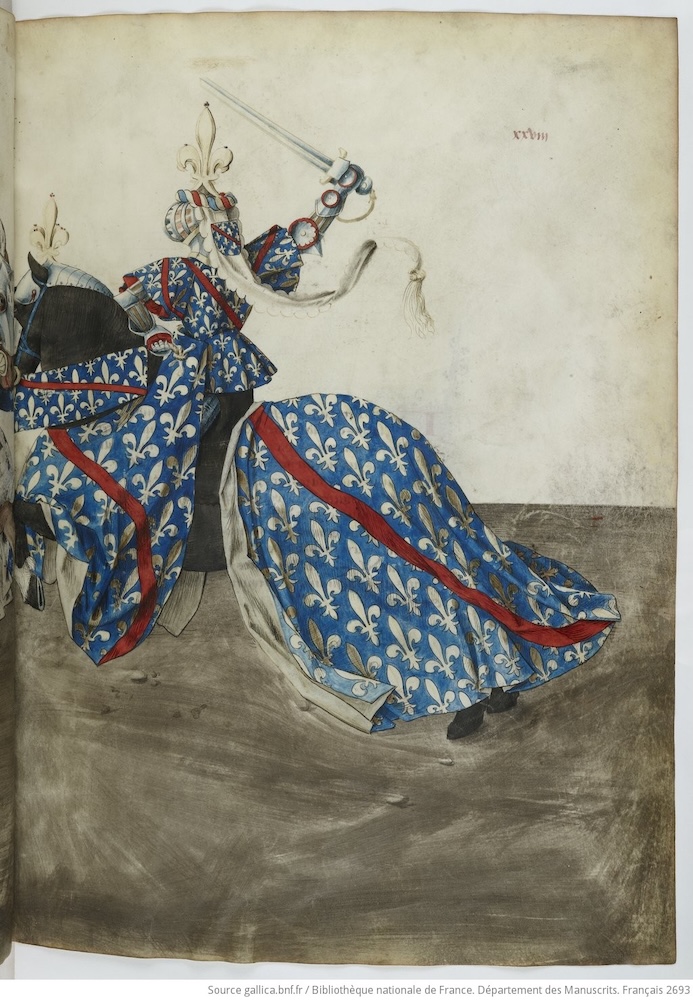
Hereafter follows how the two Dukes of Brittany and of Bourbon are on horseback, emblazoned with arms and crested, just as they will be at the tournament.
Jcy apres sensuit comment Les deux ducz de bretaigne et de bourbon sont acheual armoyez et timbrez ainsy quilz seront au tournoy ·
Folios 27 verso and 28 recto
Folios 27 (verso) and 28 (recto) contain side-by-side full-page illustrations of the two Dukes of Brittany and of Bourbon are on horseback, emblazoned with arms and crested, just as they will be at the tournament (see fith and sixth images in Illustrations below).
Illustrations
Previous Section: Specialized Arms and Armour
Next Section: Layout of the Field - Still Under Development
GLOSSARY OF TERMS
Banneret - a knight banneret led troops under his own square-shaped banner as opposed to a tapering standard or pennon flown by lower-ranking knights. Under English custom the rank of knight banneret could only be conferred by the sovereign on the field of battle
Bascinet - fully enclosed helmet attached to the breastplate and backplate, making it difficult to remove; helmets for a duel often had a locking visor, although most war visors did not lock in place.
Béhourd - a form of tournament combat that occurred within the barriers, or lists, between a large number of competitors simulating a battle.
Capeline - a type of helmet named for its resemblance to a brimmed hat; also referred to as a war hat or kettle hat.
Cuirass - armour for the torso protecting the breast and back.
Defendant - the party or representative defending against the charge or suit; in tournaments, the side being challenged.
Doublet, arming - foundational garment worn underneath armour. See What Lies Beneath: the Arming Doublet for more information.
Hourt - padded chest protection for horses.
Judge-Speakers - imperfect translation of the French Juges diseurs referring to a type of judges who would make announcements.
King of Arms - expert in heraldry and noble lineages; chief authority for that granting of armorial bearings.
Lists - wooden fence-like barriers that surround a tournament field, whether for mounted or dismounted combat.
Peytral - protective armour for a horse's chest.
Pursuivant - an attendant to a herald.
Rerebrace - armour protecting the upper arm between the armpit and elbow, formed from a single C-shaped plate or a pair of hinged plates.
Shaffron - protective armour for a horse's head; also spelled chanfron, chamfron, champfrein.
Tonlet - skirt-like armour protecting the waist in the form of overlapping lames of steel.
Torse - a wreath-like crown normally made of two fabrics twisted together and worn atop the helmet.
Vambrace - armour protecting the lower arms consisting of a pair of hinged plates formed to protect the arms between the elbows and wrists
Sources:
Source: Bibliothèque nationale de France. Département des Manuscrits. Français 2693Author: René I (duc d'Anjou ; 1409-1480). Auteur du texte. René I d’Anjou, Traité de la forme et devis comme on peut faire les tournois. 1401-1500
Translation and transcription by Gemini 3.6, November 2026.